2026-08-31
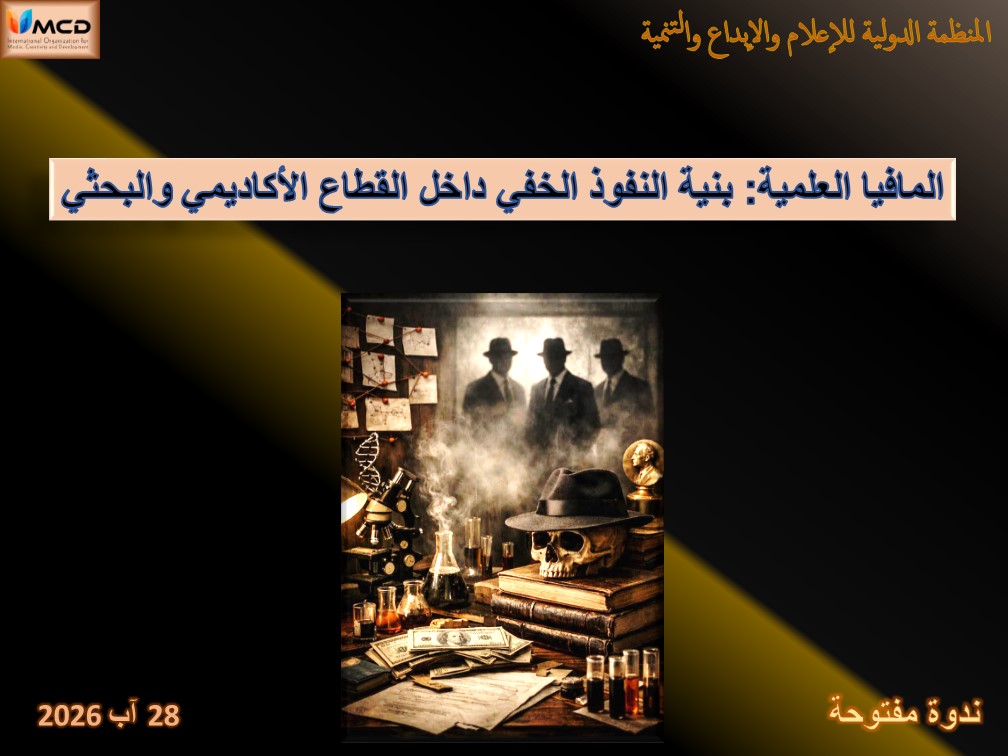
On August 28, 2026, the International Organization for Media, Creativity, and Development held an open seminar through its electronic platform, in which many academics and specialists from various fields participated, exchanging their viewpoints and experiences regarding: “The Scientific Mafia: The Structure of Hidden Influence within the Academic and Research Sector.”
This session was moderated by the President of the Organization, Dr. Madeleine Kassab, who focused in her introduction on the importance of studying the relationship between science and the nature of human psychology, and the necessity of delving into the philosophy of science and the mechanisms of knowledge formation within the context of human psychological variables. She believes that addressing any imbalance is linked to ethics, ethics are linked to elevation, elevation is linked to detachment in the search for truth, and detachment is linked to the individual “ego,” its characteristics, and the possibility of harnessing its positive capacities away from desire, selfishness, and personal gain.
Below are the main themes addressed in the seminar:
1- Defining the “Scientific Mafia” as a closed, invisible network of influence within academic and research institutions that controls: funding, scientific publishing, promotions, awards, and the shaping and consolidation of “scientific truth.” This mafia is not a criminal organization in the legal sense, but rather an undeclared alliance between groups of researchers, laboratory heads, scientific journal editors, and funding entities, aiming to: protect their interests, enhance their academic influence, exclude competitors, and control the directions of scientific research. These networks adopt informal yet effective mechanisms capable of turning science into a domain of influence not very different from politics and economics.
2- Mechanisms of the “Scientific Mafia”
- Controlling scientific publishing, which is the heart of scientific authority. The mafia controls it through: major journal editors, peer‑review committees, and citation networks. Several investigations have revealed and confirmed the existence of “closed circles” among editors in numerous scientific journals, where they pass papers for their friends and obstruct the papers of competitors, leading to the exclusion of many young researchers.
- Monopolizing scientific funding, which represents the lifeline of any research. The “Scientific Mafia” controls: university grants, government funding, corporate funding, and international grants.
- Manufacturing scientific stardom, where some scientists become “brand names,” amplified academically and in the media, while others are ignored despite the quality of their work.
- Excluding undesirable voices. Researchers are excluded through: rejecting the publication of their work, preventing their promotions, damaging their academic reputation, depriving them of funding, and ignoring their work in conferences.
3- The “Scientific Mafia” in the Arab World. This mafia takes a different form, relying on: family relations, political loyalties, partisan or sectarian affiliations, university influence, and control over promotion committees. Some Arab universities grant promotions based on the number of publications regardless of their quality, creating a large market for publishing in predatory journals. Promotion committees also reject excellent research because it does not align with the “school of the supervisor.” Additionally, some researchers are excluded because they do not belong to the networks of influence within the university.
4- The “Scientific Mafia” in Europe and the United States — Selected Examples:
- Fake peer‑review scandals in Springer and Elsevier. Between 2012 and 2015, more than 500 scientific papers were retracted after discovering that some researchers had created fake identities for peer review, confirming the fragility of the scientific publishing system.
- The “Harvard Chemistry Scandal.” In 2020, the head of the Chemistry Department at Harvard was investigated due to undisclosed funding relationships with foreign entities, revealing a network of influence within the department that controlled funding and hiring.
- Artificial intelligence monopolies in Big Tech. Companies such as Google, OpenAI, and Meta control: data, infrastructure, researchers, and scientific publishing in Artificial Intelligence, imposing a specific scientific narrative regarding AI ethics.
5- How Scientific Truth Is Made. Science is not entirely neutral; it is a field of struggle over influence. “Scientific truth” is not always produced by the scientific method but is subject to numerous variables, including: who owns the funding, who owns the laboratory, who owns the journal, who owns the network of relationships, and who has the ability to exclude others.
6- The serious consequences of the “Scientific Mafia” include: slowing innovation, excluding young talents, inflating unimportant research, creating “official science” and “unofficial science,” turning universities into bureaucratic structures, politicizing knowledge, and distorting scientific research pathways.
7- Mechanisms for dismantling the “Scientific Mafia” include: reforming the peer‑review system, ensuring funding transparency, supporting young researchers, establishing open publishing platforms, protecting research freedom, monitoring promotion committees, and strengthening university independence.
Conclusion
The “Scientific Mafia” is not a fantasy, but a real structure of influence that permeates academic institutions globally. Understanding it and recognizing its mechanisms is the first step toward liberating science from monopoly and restoring its essence: the search for truth, not the search for power and influence.